14/05/2026
Kosovar Centre for Security Studies (KCSS)
Funded by the European Union
Dr Adelina Hasani and Jon Limaj
Gender ideology has been considered one of the pillars contributing to the rise of far-right extremism. Far-right extremism, a growing concern across Europe, is characterized by authoritarianism, anti-democratic ideologies, and exclusionary nationalism. This movement undermines democracy, promotes hatred toward foreigners, and targets women, LGBTIQ+ individuals, and minority groups. In Kosovo, efforts to address extremism have primarily focused on religious extremism, leaving far-right extremism relatively underexplored. However, as new trends emerge, it is increasingly important to examine this phenomenon within Kosovo’s unique social and historical context. Gender equality has become central to far-right ideological discourse. Gender equality activists, women, and scholars working in this field are frequently targeted and portrayed as threats to the nation. As Butler explains, gender is framed not only as a threat to children, national security, heterosexual marriage, and the normative family, but also as part of an alleged plot by elites to impose their cultural values on “ordinary people.” Moreover, the targeting of sexual and gender minorities as “dangerous” to society, aimed at stripping them of fundamental rights and protections, links anti-gender ideologies to fascist thought. This further highlights the close connection between gender ideology and ethnic nationalism.
In recent years, concerns have grown about the potential for violent right-wing extremism in the Western Balkans, including Albania, Bosnia and Herzegovina (BiH), Kosovo, Montenegro, North Macedonia, and Serbia. The region has historically been perceived as politically volatile, with a legacy of violence rooted in right-wing political ideologies and actions. Over the years, gender ideologies have risen in the Western Balkan countries, which have also been very much related to ethnic nationalism. These movements portray “gender ideology” as an existential threat to traditional values, national identity, and social stability, and they use this to fuel a broader agenda that restricts human rights and weakens democratic norms. The rise of the anti-gender movements in the Western Balkans is not an isolated phenomenon; they are part of a broader transnational network that strategically aligns itself with far-right political actors, conservative religious institutions, and populist regimes across Europe. And that is common among all these rising anti-gender movements in Europe, that they are driven by the great wish of restoring the patriarchal dream order where a father is a father, and women, conceived as born female at birth, resume their natural and moral position within the household.
Across Europe, the term "gender ideology" has become a central concept used to oppose perceived ideological ideas such as gender equality, abortion, sexual education, reproductive rights, and LGBTIQ+ rights. Anti-gender mobilizations take various forms, from opposing same-sex marriage to protesting against abortion. However, they often converge around the idea of a "threat to the family" and the need to defend it. The family they seek to protect is exclusively a heterosexual, heteronormative unit comprising a (married) mother, father, and children, a "traditional family." This "complete family" is portrayed as the only "healthy" environment for raising children. Consequently, protecting this family equates to safeguarding children, restoring traditional family models, and resisting perceived threats such as socio-economic and demographic trends, divorces, shifts in "natural" gender roles, or LGBTIQ+ rights.
While anti - gender ideas have a long historical pedigree, the expansion of the internet has created new spaces in which these concepts have mutated and proliferated. Feminists are often framed by anti-gender groups as primary adversaries, accused of undermining conservative social norms. Often frames masculinity as being in crisis and positions patriarchy as a solution to this perceived gendered uncertainty. Within this discourse, the traditional family serves as an anchor for reclaiming masculinity, with religion playing a legitimizing role. While the invocation of traditional family structures lies at the core of anti-gender movements, they also mobilize around narratives of male victimhood, both in response to women’s independence and rights and to broader challenges to male supremacy.
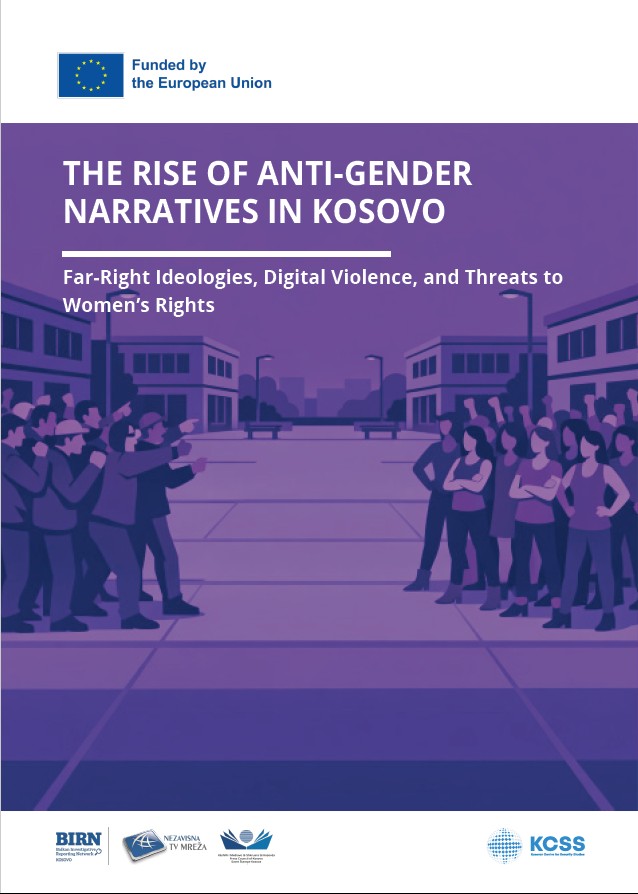
Although the anti-gender movement has not been formally traced in Kosovo, its narrative is widely embraced and circulated among individuals, particularly on social media, where it has primarily manifested as hate speech targeting women in the political and public spheres. As will be discussed, this narrative emerged and was further crystallized in response to the Civil Law article on same-sex unions. They have been manifested as traditionalist pushback against gender equality, fueled by nationalism and religion, challenging women's rights, LGBTQ+ rights, and reproductive health through disinformation, political rhetoric, and cultural pressures that reinforce stereotypes and patriarchal norms, creating a risk of societal regression despite legal frameworks for equality. Anti-gender narratives in Kosovo falsely portray gender equality as a Western imposition, aiming to re-traditionalize society, often linking it to hypermasculinity and resisting advancements in gender rights and sexual education, but also posing a threat to women’s security and well-being. These narratives leverage disinformation and fear to polarize public opinion. They deliberately associate concepts of gender diversity and LGBTIQ+ rights with misinformation about the "destruction of the traditional family."
While Kosovo does not have a formally organised anti-gender group or movement, anti-gender narratives are embedded in hate speech targeting women and in various forms of gender-based violence (GBV), particularly on online platforms. These practices function as tools commonly employed by anti-gender actors. Online GBV reinforces patriarchal norms, polices gender boundaries, and mobilises political or social opposition to gender equality.
This report situates online GBV within broader anti-gender networks, far-right ideologies, and transnational movements that deliberately target women, LGBTI+ individuals, and activists. While anti-gender narratives often frame feminism, LGBTI+ rights, and reproductive rights as “threats” to traditional values, online GBV operationalizes these narratives in everyday digital spaces. Gender ideologies are disseminated online through tactics such as deepfakes, non-consensual image sharing, doxing, and cyberstalking, which are used to intimidate, discredit, or silence targeted individuals.
The translation of report in Serbian Language can be found here: USPON ANTIRODNIH NARATIVA NA KOSOVU Desničarske ideologije, digitalno nasilje i pretnje ženskim pravima
This publication was funded by the European Union. Its content is the sole responsibility of the Kosovar Centre for Security Studies and does not necessarily reflect the views of the European Union or BIRN.